Carvaka, also called Lokayata (“those of the world”), was India’s materialist school. It rejected the authority of the Vedas, denied that there is any soul apart from the body, any rebirth, karma or afterlife, and accepted only one source of knowledge: what we perceive.
“As long as you live, live happily; even if you must borrow, drink ghee.”A Carvaka verse preserved in the Sarvadarshanasangraha (14th century)
 Illustration: perception, the only valid source of knowledge for the Carvakas, and the four elements they held everything is made of
No Carvaka text survives. A founding work, the Brihaspati Sutra, is lost; what we know comes mostly from rivals who quoted the school in order to refute it — above all the first chapter of Madhava’s Sarvadarshanasangraha, a 14th-century survey of Indian philosophies. Early Buddhist texts describe a contemporary of the Buddha, Ajita Kesakambali, teaching a similar materialism, so ideas of this kind are very old. One radical sceptical work from the Lokayata tradition does survive: Jayarashi Bhatta’s Tattvopaplavasimha, from around the 8th century.
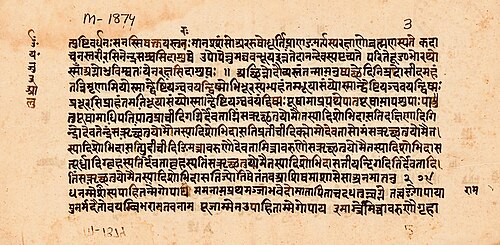 Carvaka's own texts are lost; this Vedic manuscript represents the authority it argued against — Ms Sarah Welch, CC BY-SA 4.0
The Carvakas’ sharpest argument was against inference. To infer fire from smoke, you need the general rule “where there is smoke, there is fire”. But no one has perceived every case of smoke, past and future, so the rule itself cannot be known — and every inference rests on it. It is an argument about induction that Western philosophy would meet again in David Hume, and one the Nyaya logicians worked hard to answer.
Everything, the Carvakas held, is made of four elements: earth, water, fire and air. Consciousness is not a separate soul but something that arises when these elements combine in a living body — as the power to intoxicate arises when certain ingredients are fermented together, though none has it alone. When the body dies, consciousness ends.
If there is no next life, the sensible goal is a happy life in this one. Their opponents painted the Carvakas as crude pleasure-seekers, and quoted verses mocking priests and rituals: offerings to the dead, they said, are as useful as feeding one traveller to fill another’s stomach. Whether the real Carvakas were as crude as their critics claimed is impossible to know, since we hear them only through those critics.
Carvaka and the others: against Vedanta it denied Brahman and liberation; against Buddhism and Jainism it denied karma and rebirth; against Nyaya it allowed perception alone. It was the outsider every school had to answer.
The Carvakas are a reminder that ancient India was not only a land of mystics: it also had thoroughgoing sceptics and materialists. In 1959 the philosopher Debiprasad Chattopadhyaya’s book Lokayata revived interest in them, and today they are often claimed as forerunners of Indian rationalism.