The Ajivikas were an ascetic movement of ancient India, rivals of the Buddhists and the Jains in the 5th century BCE. Their leading teacher was Makkhali Gosala, a contemporary of the Buddha and of Mahavira. Jain texts say Gosala spent some years as Mahavira’s companion before the two parted bitterly.
Their central teaching was niyati, fate: everything that happens, including every human choice, is fixed in advance. The movement drew royal patronage under the Mauryas and survived, in South India, for well over a thousand years.
A caution about sources: no Ajivika text survives. Almost everything we know comes from their rivals — Buddhist and Jain scriptures that describe them unsympathetically — and from a few royal inscriptions. The classic modern study is A. L. Basham’s History and Doctrines of the Äjīvikas (1951).
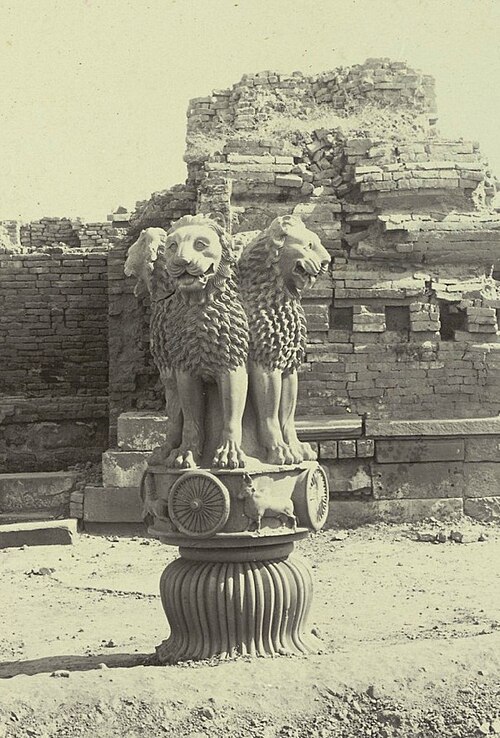 The Lion Capital of Ashoka, Sarnath — the emperor who gave the Barabar caves to Ajivika monks (photo c. 1905, public domain)
“Just as a ball of string, when thrown, unwinds to its full length, so fools and wise alike will make an end of sorrow.”Gosala’s teaching, as described in the Samannaphala Sutta (Digha Nikaya 2)
 Illustration: Gosala’s image of fate — a ball of string unwinding to its full length
According to the Buddhist account, Gosala taught that there is no cause for the defilement or the purification of beings, and that human effort and energy change nothing. Every soul passes through a fixed round of rebirths — the texts give the number as 8,400,000 great aeons — and at the end of it, sorrow ends, whatever the person has done.
This is what set the Ajivikas apart. Buddhists and Jains also believed in rebirth and liberation, but for them action (karma) shaped the journey, so how you lived mattered. For the Ajivikas the sequence was already settled; effort could not shorten it. One Buddhist sutta compares Gosala’s doctrine to a hair blanket, the worst of all woven cloths.
The surprising part is how the Ajivikas lived. They were strict ascetics: they went naked, fasted severely, and some ended their lives by fasting. Their rivals saw a contradiction — why practise if nothing can change? — but perhaps the Ajivikas saw their austerities as part of what fate had already laid out for them. Some were also known as fortune-tellers, which fits a belief that the future is fixed and can be read.
A related teacher, Pakudha Kaccayana, is described as holding that the world is made of seven eternal, unchanging “bodies”: earth, water, fire, air, joy, sorrow and the soul. Whether this was Ajivika doctrine or his own is unclear.
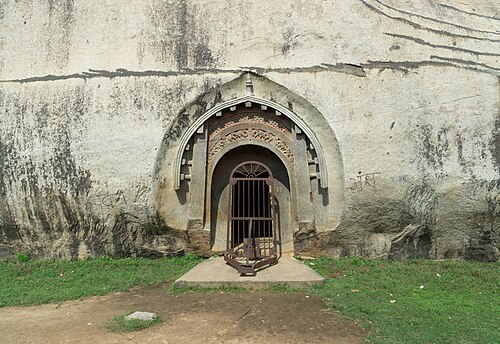 Sumitsurai, CC BY-SA 4.0
The strongest physical evidence of the Ajivikas is in stone. Inscriptions in the Barabar Caves near Gaya record that the emperor Ashoka gave caves there to Ajivika ascetics, and his grandson Dasharatha dedicated more in the nearby Nagarjuni Hills. Ashoka also names the Ajivikas, alongside Buddhists, Brahmins and Jains, among the communities his officials were to look after.
The movement later faded from the north but lasted in South India, where Tamil inscriptions still mention a tax on Ajivikas around the 13th and 14th centuries. By then their teaching may have changed considerably from Gosala’s.
The Ajivikas offered one of the earliest thorough-going determinisms in any philosophy: a universe where every event, every choice and every life’s end is already written. That puts them at the start of an argument that has never closed — and makes them an interesting partner in dialogue with the Stoics, who also believed in fate but held that we still choose how we meet it.
This idea raises important questions:
Is life truly predetermined?
Do we have any free will?
How do these philosophies compare with other Indian schools like Jainism and Buddhism?
The Ajivikas on Wikipedia · A. L. Basham, History and Doctrines of the Äjīvikas (1951)