Ten schools, two millennia of argument, one old question: what is real, how do we know it, and how do we get free?
Darshana comes from the Sanskrit root drish, “to see”. A darshana is a view — a way of seeing reality, worked out with argument and handed down through commentaries. A darshanik is someone who holds such a view: a philosopher. That is where this site takes its name.
Classical Indian thinkers sorted the schools by one question: do they accept the authority of the Vedas? Those that did are called astika; those that did not, nastika. The words describe a stance toward scripture, not belief in God — Samkhya and Mimamsa, both astika, explain the world without a creator, while Buddhism and Jainism reject the Vedas and still offer complete paths to liberation.
A later tidying-up: the neat list of “six orthodox schools” is a medieval convention. Earlier surveys counted differently — the 8th-century Jain scholar Haribhadra’s Compendium of Six Views included Buddhism and Jainism among its six, and the 14th-century Sarvadarshanasangraha describes sixteen.
They are traditionally grouped in three pairs, each pair sharing a great deal: Nyaya and Vaisheshika (how we know, and what exists), Samkhya and Yoga (the theory of spirit and matter, and the practice), Mimamsa and Vedanta (the ritual Veda, and the philosophical Upanishads).
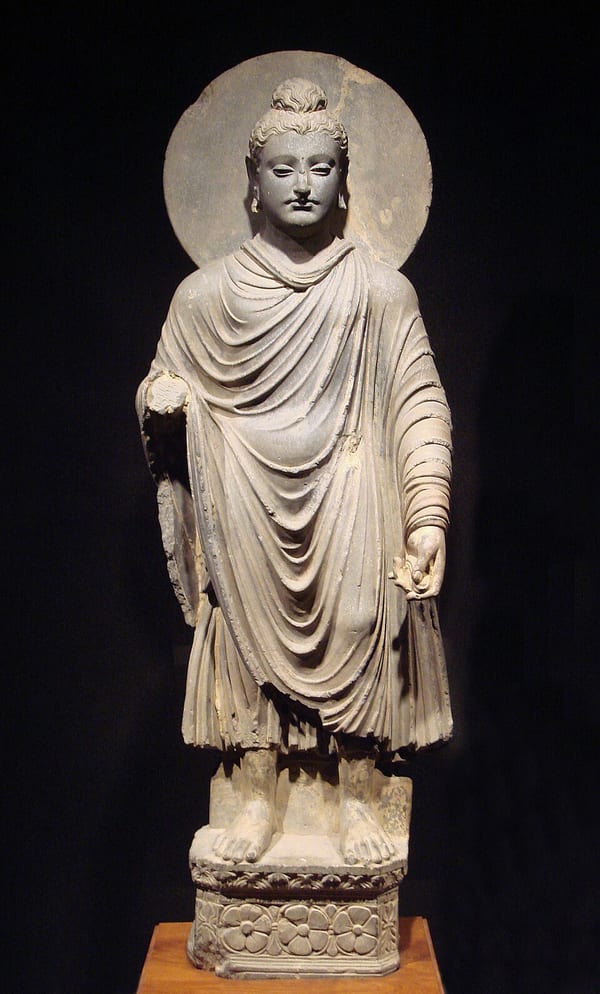
Around the 5th century BCE, wandering teachers known as shramanas challenged Vedic ritual and priestly authority. Two of their movements became world religions; two vanished, known now mostly through their rivals’ descriptions.
Every school had to answer the same questions: how can we know anything, what is the self, and what is the goal of life? A simplified comparison:
| School | Root text | Ways of knowing | The self | The goal |
|---|---|---|---|---|
| Nyaya | Nyaya Sutras (Gautama) | Perception, inference, comparison, testimony | Many real, eternal selves | Release from suffering through right knowledge |
| Vaisheshika | Vaisheshika Sutra (Kanada) | Perception, inference | Many real, eternal selves | Release through knowing the categories of reality |
| Samkhya | Samkhya Karika (Ishvarakrishna) | Perception, inference, testimony | Many purushas, pure witnesses | Kaivalya: spirit isolated from matter |
| Yoga | Yoga Sutras (Patanjali) | Perception, inference, testimony | As Samkhya, plus a special purusha, Ishvara | Kaivalya through stilling the mind |
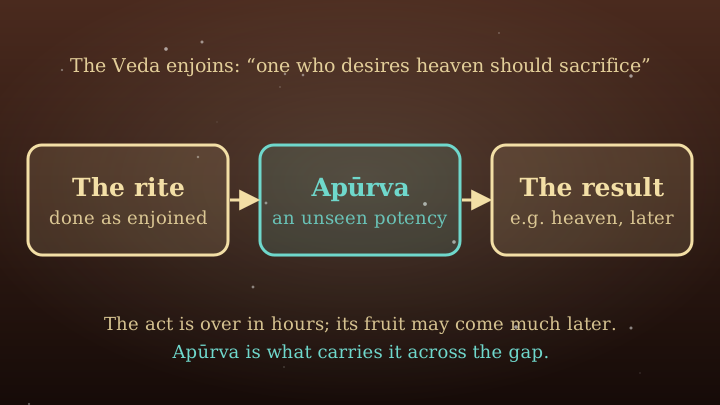
| Mimamsa | Mimamsa Sutras (Jaimini) | Up to six, adding postulation and non-apprehension | Many real, eternal selves | Doing one’s dharma; heaven, and in later writers liberation |
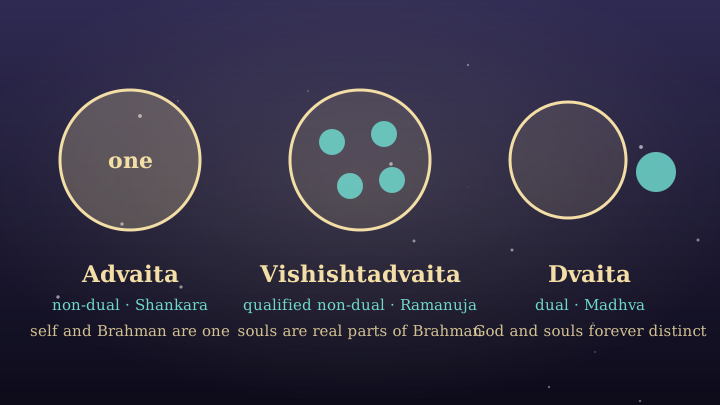
| Vedanta | Upanishads, Gita, Brahma Sutras | Six, in Advaita; scripture alone reveals Brahman | Advaita: the self is Brahman | Moksha: knowing, or reaching, Brahman |
| Buddhism | Pali Canon; later Dignaga and Dharmakirti | Perception, inference | No permanent self (anatta) | Nirvana |
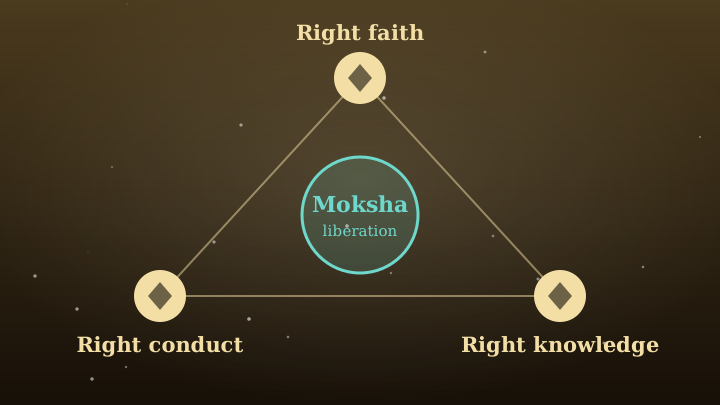
| Jainism | Tattvartha Sutra (Umasvati) | Direct and indirect knowledge | Countless souls (jiva) | Moksha: the soul freed of karmic matter |
| Carvaka | Brihaspati Sutra (lost) | Perception only | Nothing beyond the living body | Pleasure, in this one life |
| Ajivikas | No texts survive | Unknown | Souls exist, but fate (niyati) rules them | Release, but only when fate allows |
The darshanas grew up in conversation with each other. A classical treatise typically opens by stating the opponent’s position in its strongest form — the purvapaksha, “prior view” — before answering it. Nyaya logicians debated Buddhist logicians for centuries; Vedantins refuted Samkhya; Mimamsakas argued with everyone. To read one school is to overhear an argument with all the others.
Indian philosophy on Wikipedia · Stanford Encyclopedia: Epistemology in Classical Indian Philosophy