The Bhagavad Gita ("Song of God") is a 700-verse Hindu scripture embedded within the sixth book of the vast Indian epic the Mahabharata. Framed as a dialogue on the eve of a great battle, it has become one of the most widely read spiritual texts in the world — not a ritual manual, but a compressed philosophical meditation on duty, action, and the nature of the self.
The Gita opens at the battlefield of Kurukshetra, where the warrior-prince Arjuna, facing the prospect of killing kinsmen, teachers, and friends arrayed on the opposing army, is overcome with grief and refuses to fight. His charioteer — who is revealed to be Krishna, an avatar of the god Vishnu — responds not with simple reassurance but with an extended philosophical teaching spanning eighteen chapters, each traditionally called a "yoga."
Composed likely between the 2nd century BCE and 2nd century CE, though dramatically set in a much older legendary past, the Gita is traditionally attributed to the sage Vyasa, the same figure credited with compiling the entire Mahabharata.
Krishna's response to Arjuna's crisis lays out several interwoven paths to liberation, all valid according to a person's temperament:
Karma Yoga — the discipline of action performed without attachment to results: "You have a right to your actions, but never to the fruits of your actions."
Bhakti Yoga — devotion and surrender to the divine as a direct path to liberation
Jnana Yoga — the path of knowledge, discriminating between the eternal self (atman) and the transient body
Dhyana Yoga — meditative discipline for steadying the mind
Underlying all of these is the teaching that the soul is eternal and unaffected by the body's death — "Weapons cannot cut it, fire cannot burn it, water cannot wet it, wind cannot dry it" — which reframes Arjuna's dilemma: his duty (dharma) as a warrior must be fulfilled with equanimity, since the true self is never actually destroyed.
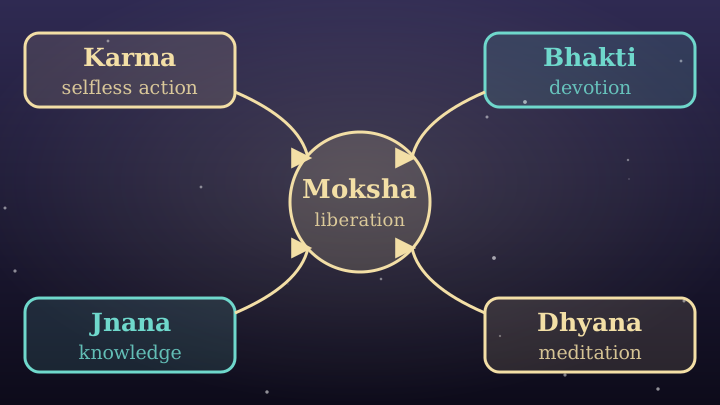 Illustration: the Gita’s four paths — different temperaments, one goal
In the Gita's eleventh chapter, at Arjuna's request, Krishna grants him a vision of his universal form (vishvarupa) — a terrifying, boundless revelation containing all beings, all time, and all destruction within it. It is this passage that physicist J. Robert Oppenheimer famously recalled after the first nuclear test in 1945, quoting Krishna's words: "Now I am become Death, the destroyer of worlds."
The Gita's influence extends far beyond Hindu religious practice. Mahatma Gandhi called it his "spiritual dictionary," returning to it throughout his life for guidance on non-attached action; Aldous Huxley, Ralph Waldo Emerson, and Henry David Thoreau all engaged deeply with its ideas. Its central teaching — act with full commitment, but release attachment to outcome — remains one of the most widely cited pieces of practical philosophy from any tradition.
Key Figures: Krishna, Arjuna, the sage Vyasa
Related Topics: Karma yoga, dharma, the Mahabharata, Vedanta
Bhagavad Gita on Wikipedia · Britannica: Bhagavad Gita · Vedanta