The Tao Te Ching ("The Way and Its Power") is the foundational text of Taoism — roughly 5,000 Chinese characters divided into 81 short chapters, traditionally attributed to the sage Laozi ("Old Master"). Legend holds that Laozi, a court archivist disillusioned with the corruption of his age, dictated the text in a single sitting to a border guard before riding off into the mountains, never to be seen again.
Modern scholarship treats Laozi's historicity as uncertain and dates the text's compilation to roughly the 4th century BCE, likely assembled from older oral material rather than written by a single hand at one moment.
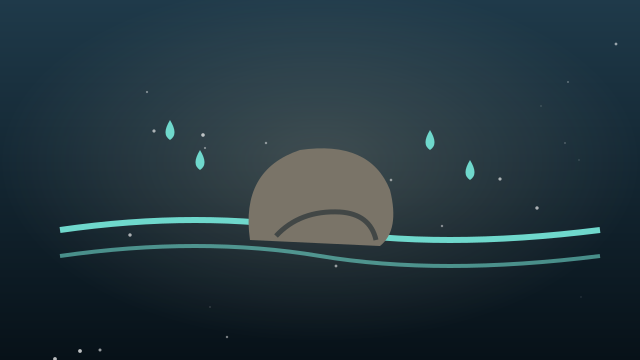 Illustration: soft water wears away hard stone (Tao Te Ching 78)
The text opens with one of the most famous lines in world philosophy: "The Tao that can be spoken is not the eternal Tao. The name that can be named is not the eternal name." The Tao ("the Way") names the ineffable, generative principle underlying all existence — not a deity to be worshipped, but the natural order itself, prior to and beyond all human categories and language.
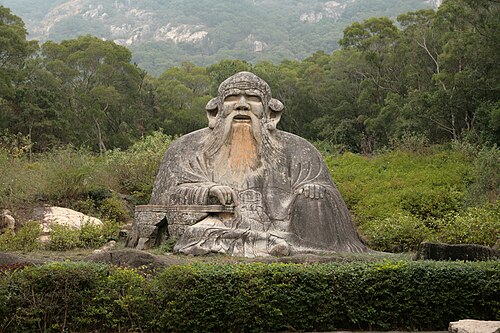
Laozi, traditionally credited as the author of the Tao Te Ching
The text's central practical teaching is wu wei, often translated "non-action" or "effortless action" — not passivity, but action so perfectly aligned with the natural flow of things that it requires no strain or force. The Tao Te Ching repeatedly illustrates this through paradox: water, the softest of substances, wears down stone; the sage leads by staying behind; the truly strong appear yielding.
"The highest good is like water. Water benefits all things and does not compete. It dwells in places that people disdain, and so it is close to the Tao."
This is closely tied to the text's political philosophy: the ideal ruler governs so lightly and unobtrusively that the people believe they achieved order themselves — a striking contrast with the elaborate ritual and hierarchy prescribed in Confucian thought.
The Tao Te Ching also gave lasting currency to the complementary poles of yin and yang — not opposites in conflict, but interdependent forces that generate each other in constant cycle. Its ideal person is likened to p'u, the "uncarved block": simple, unadorned, and full of latent potential precisely because it has not been shaped into any single fixed form.
The Tao Te Ching became one of the two central pillars of Taoism — alongside the more playful, story-driven Zhuangzi — and profoundly shaped Chinese art, medicine, martial arts, and statecraft for over two thousand years. It is also, after the Bible, among the most translated texts in world literature, and its emphasis on simplicity and non-striving has found a large modern Western readership in management theory, ecology, and mindfulness practice.
Key Concepts: Tao, wu wei, yin-yang, the uncarved block
Related Topics: Taoism, the Zhuangzi, Confucian ritual (li)
Tao Te Ching on Wikipedia · Stanford Encyclopedia: Laozi · Chinese Text Project: Dao De Jing