Laozi (“Old Master”) is traditionally the author of the Tao Te Ching, one of the most translated books in the world. Almost nothing about his life is certain. The historian Sima Qian, writing around 94 BCE, gives the classic story — an archivist at the Zhou court who met Confucius, then left China through a western mountain pass, where the keeper of the pass asked him to write down his teaching — but Sima Qian himself admits that accounts differ.
Most scholars now see the Tao Te Ching as a text that grew over time. The oldest copies yet found, written on bamboo slips and buried around 300 BCE, were discovered at Guodian in 1993.
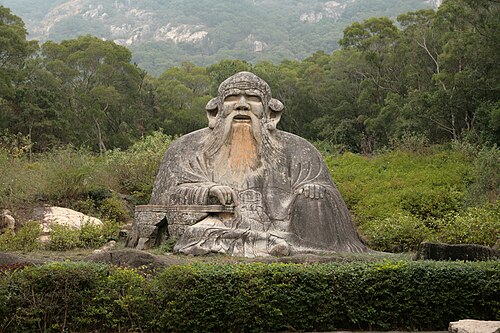 Tom@HK, CC BY 2.0
“The Tao that can be told is not the eternal Tao.”Tao Te Ching 1
The Tao (“the Way”) is the source and pattern of everything, but it cannot be captured in words or concepts. The book is only about 5,000 characters long, in 81 short chapters, and it teaches by paradox and image rather than argument.
“The Tao does nothing, yet nothing is left undone.”Tao Te Ching 37
Wu wei is often translated “non-action”, but it means something closer to not forcing: acting in harmony with how things naturally unfold, without strain or grasping. The sage leads without dominating and achieves without boasting.
“The highest good is like water, which benefits all things without contention.”Tao Te Ching 8
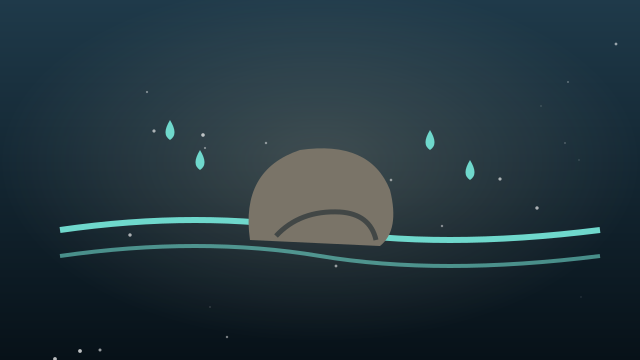 Illustration: soft water wears away hard stone (Tao Te Ching 78)
Water is the book’s favourite image: soft and yielding, yet nothing is better at wearing down the hard and strong. Laozi praises the lowly place, simplicity, few desires and knowing when to stop.
“He who knows others is wise; he who knows himself is enlightened.”Tao Te Ching 33
The Tao Te Ching is also a book about government. It warns against too many laws and too much interference — governing a large state, it says, is like cooking a small fish: stir it too much and it falls apart (chapter 60).
The Tao Te Ching falls into two parts: chapters 1–37 on the Tao, the Way, and chapters 38–81 on De, its “virtue” or power, the quiet strength of someone in harmony with the Way. The silk manuscripts found in 1973 in a tomb at Mawangdui, sealed in 168 BCE, place the De part first, a reminder that the book's shape changed as it was copied.
Its chapters are short, rhythmic and often rhymed in Chinese, built from paradoxes: the soft overcomes the hard, the empty is useful, the one who does not compete cannot be defeated. Translators disagree constantly, which is part of the reason there are hundreds of English versions.
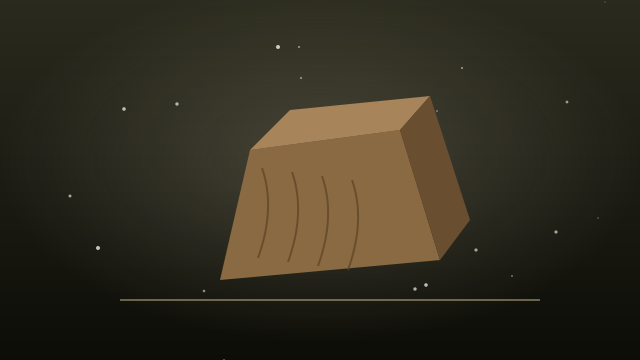 Illustration: the uncarved block: simplicity before shaping
“Manifest plainness, embrace simplicity, reduce selfishness, have few desires.”Tao Te Ching, chapter 19
Laozi's image for the simple, original nature of things is pu, the uncarved block of wood. Once carved into tools and vessels it becomes useful but limited; uncarved, it holds every possibility. Civilisation's endless naming, ranking and wanting, the book suggests, carves people into narrower shapes. The sage returns to simplicity: plain food, few desires, contentment with enough.
“Whoever acts on it ruins it; whoever grasps it loses it.”Tao Te Ching, chapter 64
Sima Qian's Records of the Grand Historian tells of a meeting in which Confucius asked Laozi about ritual and was told to drop his pride and ambition. Afterwards Confucius is said to have compared Laozi to a dragon, beyond his understanding. Historians doubt the meeting took place, but the story captures a real contrast that runs through Chinese thought: Confucian effort, learning and social order on one side, Daoist naturalness and letting-be on the other.
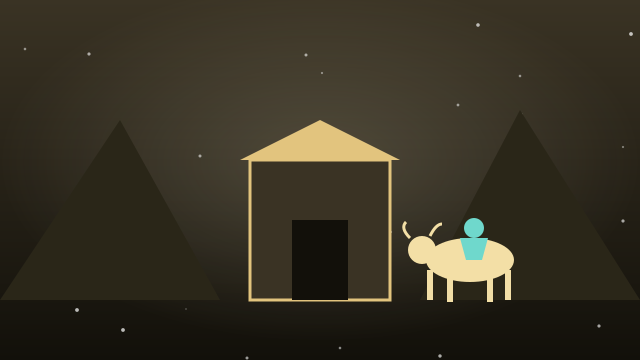 Illustration: Laozi riding an ox out through the western pass
From the 2nd century CE, the Celestial Masters movement founded by Zhang Daoling revered Laozi as a god who had revealed the Way, and religious Daoism grew from there. The philosopher and the deity have lived side by side ever since.
Laozi became the founding figure of Daoism, and later Daoist religion honoured him as a deity, Taishang Laojun. His ideas, carried further by Zhuangzi, shaped Chinese art, medicine, martial arts and Chan (Zen) Buddhism.