Zhuang Zhou, honoured as Zhuangzi (“Master Zhuang”), lived in the 4th century BCE, during China’s Warring States period, a time of constant war and of a great flowering of rival philosophies. According to the historian Sima Qian, he came from Meng in the state of Song and held a minor post overseeing a lacquer garden. Almost everything else we know comes from stories in the book that bears his name — including his refusal of an offer to become chief minister of Chu: he would rather, he said, be a live turtle dragging its tail in the mud than a dead one honoured in a temple.
The Zhuangzi survives in thirty-three chapters, edited in the 3rd century CE by Guo Xiang. Scholars generally attribute the first seven, the “Inner Chapters”, to Zhuangzi himself, and the rest to followers and later writers. Where the Tao Te Ching is compressed and oracular, the Zhuangzi is sprawling, playful and full of characters — talking trees, butchers, cripples, giant birds and a frog in a well who thinks its puddle is the whole world.
His most famous passage, from the second chapter, tells how Zhuang Zhou once dreamed he was a butterfly, fluttering happily and knowing nothing of Zhuang Zhou. He woke, and was Zhuang Zhou again — but could not tell whether he was a man who had dreamed of being a butterfly, or a butterfly now dreaming of being a man. The point is not a riddle to solve but a loosening: our fixed categories, even “I”, are less solid than we think, and things are always transforming into one another.
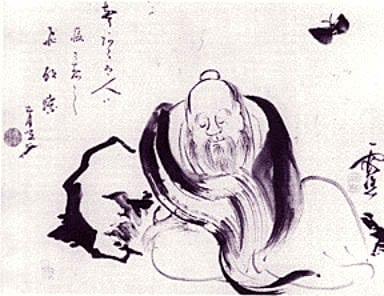 Zhuangzi dreaming of a butterfly, by the Japanese painter Ike no Taiga (1723–1776) — an imagined scene; no likeness survives. Public domain (source)
Again and again Zhuangzi turns ordinary values upside down. A gnarled tree, useless for timber, lives to a great age precisely because no carpenter wants it. Cook Ding carves an ox so skilfully that his knife never dulls in nineteen years, because he no longer hacks but follows the natural spaces between the joints — an image of wu wei, effortless action. When his wife died, a friend found Zhuangzi drumming on a basin and singing; he explained that he had grieved, then understood that her life and death were part of the same cycle as the seasons.
With Laozi, Zhuangzi is one of the two founding voices of Taoism, and his humour and scepticism influenced Chan Buddhism — better known in the West by its Japanese name, Zen. Philosophers today still read him for his questions about perspective, knowledge and the limits of language, and writers love him because, alone among the ancient sages, he is genuinely funny.
Explore more about Zhuangzi on Wikipedia.