Jainism is one of the great traditions that rejected the authority of the Vedas, alongside Buddhism, the Carvakas and the Ajivikas. Jains trace their teaching through twenty-four tirthankaras, “ford-makers” who crossed the river of rebirth and showed the way. The last, Mahavira (Vardhamana), was an older contemporary of the Buddha; Jain tradition gives his dates as 599–527 BCE, while many historians place him somewhat later. His predecessor Parshvanatha, said to have lived 250 years earlier, is widely thought to have been a real person too.
“Right faith, right knowledge and right conduct together are the path to liberation.”Tattvartha Sutra 1.1
The Tattvartha Sutra of Umasvati, written in the early centuries CE, is the one text accepted by both main branches of Jainism, the Digambaras (“sky-clad”) and the Shvetambaras (“white-clad”).
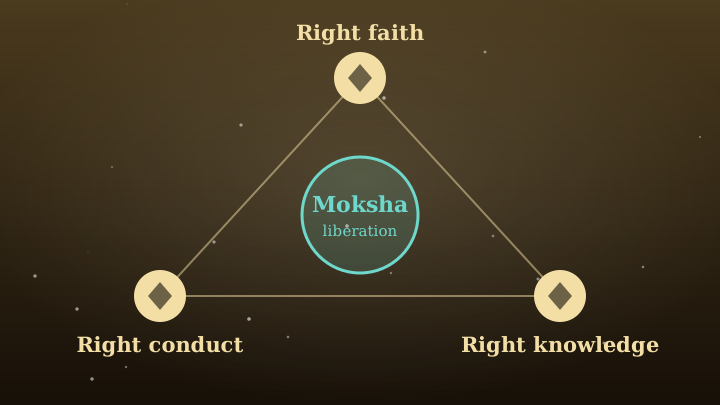 Illustration: the three jewels — not three paths, but one path with three parts
Jainism divides reality into jiva, the countless living souls, and ajiva, everything without life. Each soul is by nature all-knowing and blissful, but it is weighed down by karma — which, uniquely in Jainism, is a fine kind of matter that clings to the soul when we act with passion, like dust sticking to an oiled cloth. Liberation (moksha) is the soul’s complete release from this matter; the freed soul rises to the summit of the universe and rests there in omniscience.
There is no creator God. The universe has always existed and always will.
Ahimsa, non-violence, is the heart of Jain ethics, and it reaches further than in any other tradition. Life is everywhere: in animals and insects, but also in plants and in the tiniest beings of earth, water, fire and air. Monks and nuns take five great vows — non-violence, truthfulness, not stealing, celibacy and non-possession — and lay Jains keep gentler versions of the same five.
 Illustration: the raised hand of ahimsa, non-violence, a Jain emblem
The Jain motto, from Tattvartha Sutra 5.21: parasparopagraho jivanam — “souls render service to one another.”
Jain philosophers argued that reality is complex and every claim about it is true only from some standpoint. This doctrine of anekantavada, “non-one-sidedness”, is often illustrated with the parable of the blind men and the elephant: one feels the trunk and says “a snake”, another the leg and says “a pillar” — each partly right, none wholly. Jain logicians turned it into syadvada, a method of qualifying statements with “in some respect”, and into a sevenfold scheme of possible claims.
The result is a philosophy of intellectual humility — non-violence extended to argument itself.
Jain communities have shaped Indian commerce, scholarship and art, and Jain ideas reached far beyond them: Mahatma Gandhi counted the Jain thinker Shrimad Rajchandra among his most important teachers, and his ahimsa owes much to that influence.
Jainism on Wikipedia · Anekantavada on Wikipedia · The Tattvartha Sutra on Wikipedia