The Buddha wrote nothing, and his teachings were passed down orally for centuries before being written in the Pali Canon in Sri Lanka around the 1st century BCE. Even his dates are debated: older estimates place his life around 563–483 BCE, while many scholars now favour roughly 480–400 BCE. What follows is the traditional account, which mixes history with the stories his followers told.
Siddhartha Gautama was born at Lumbini, in present-day Nepal, into the Shakya clan, whose capital was Kapilavastu; his father, Suddhodana, was its chief. Tradition says he was raised in deliberate luxury and sheltered from hardship, married Yasodhara and had a son, Rahula. Then, on trips outside the palace, he met the “four sights”: an old man, a sick man, a corpse and a wandering ascetic. Shaken by the fact that age, sickness and death come to everyone, he left home at about twenty-nine to search for a way beyond suffering.
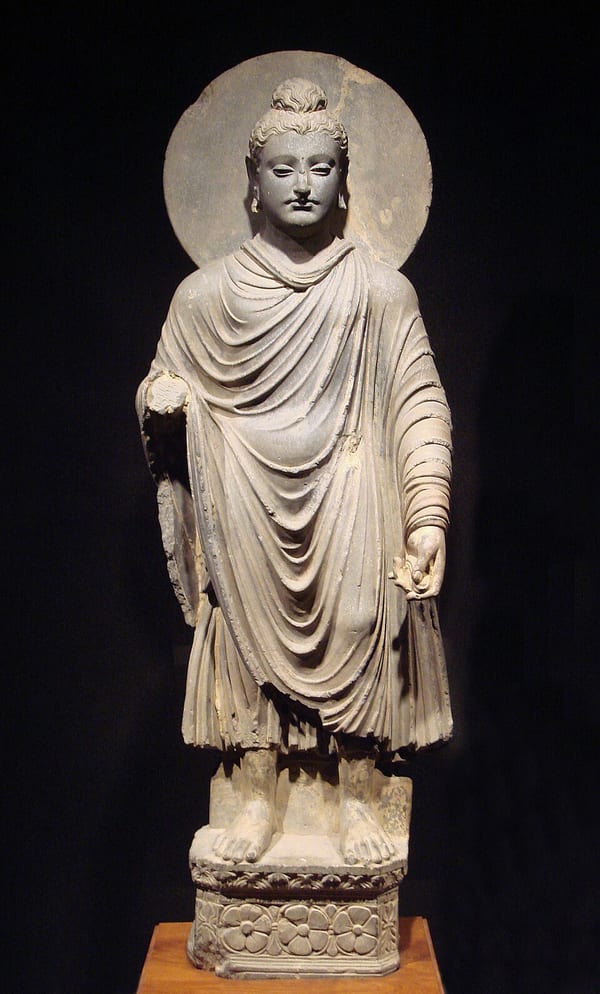 Standing Buddha, Gandhara, 1st–2nd century CE — made centuries after his death; no likeness of the Buddha survives. Tokyo National Museum, public domain (source)
He studied meditation with two renowned teachers, Alara Kalama and Uddaka Ramaputta, mastered what they taught, and found it did not end suffering. He then joined five ascetics in years of extreme self-denial, fasting until he was close to death. Concluding that self-torture was as much a dead end as indulgence, he took food — and his companions abandoned him in disgust. He called the path between the two extremes the Middle Way. Sitting beneath a fig tree at Bodh Gaya, now known as the Bodhi tree, he resolved not to rise until he understood, and at about thirty-five attained awakening (bodhi). From then on he was the Buddha, “the awakened one.”
His first teaching, given to those same five ascetics in the Deer Park at Sarnath near Varanasi, is known as “setting in motion the wheel of the Dharma.” It set out the Four Noble Truths: life involves dukkha (suffering, or unsatisfactoriness); it arises from craving; it can cease; and there is a path to its cessation — the Noble Eightfold Path of right view, intention, speech, action, livelihood, effort, mindfulness and concentration. Underneath runs his analysis of existence: everything is impermanent, conditioned, and without a fixed, unchanging self.
For some forty-five years he walked the plains of the Ganges teaching kings, merchants, outcastes and wanderers alike, and founded the sangha, an order of monks and later of nuns, beginning with his stepmother Mahapajapati. He died at Kushinagar at around eighty; his followers call it his parinirvana, final release. Spread across Asia with the help of the emperor Ashoka, his teaching grew into the Theravada, Mahayana and Vajrayana traditions, and today roughly half a billion people are Buddhists.
Explore more about The Buddha on Wikipedia.