The eight limbs and the four paths of yoga are covered on Yoga. This page goes one layer deeper — into the actual text of the Yoga Sutras, the philosophy that grounds them, and what the chakras are in the original sources versus what got added later.
The Yoga Sutras aren't a how-to manual for poses — asana is mentioned in exactly one sutra, and it just means a steady, comfortable seat for meditation. The text is 196 short aphorisms (sutras), organized into four chapters (padas):
1. Samadhi Pada — on absorption, defining what yoga is and what a settled mind looks like.
2. Sadhana Pada — on practice, including the eight limbs (see the full breakdown here).
3. Vibhuti Pada — on the powers (siddhis) said to arise from deep practice, and Patanjali's own warning about them.
4. Kaivalya Pada — on liberation, the text's actual endpoint.
The text opens with a line that's easy to skip past:
Then comes the actual definition — the sutra everything else in the text unpacks:
Chapter 3 catalogs an extensive list of siddhis — abilities like knowledge of past lives, understanding animal sounds, or extraordinary strength, said to arise from combined concentration, meditation, and absorption (samyama) on a given object. Patanjali lists them in detail and then, notably, warns that they are obstacles to samadhi if the practitioner gets attached to them — impressive, and beside the point.
The text's actual destination is kaivalya — usually translated “isolation” or “aloneness” — the state where consciousness rests entirely in its own nature, no longer entangled with the mind's activity. Not a supernatural power. The absence of the need for one.
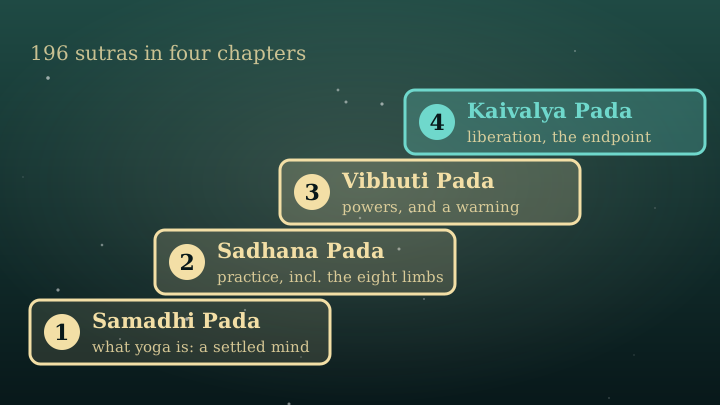 Illustration: the four padas (chapters) of Patanjali’s Yoga Sutras
Patanjali's system is built on top of Samkhya, one of India's oldest philosophical schools, and borrows its basic map of reality wholesale. Samkhya proposes a strict duality:
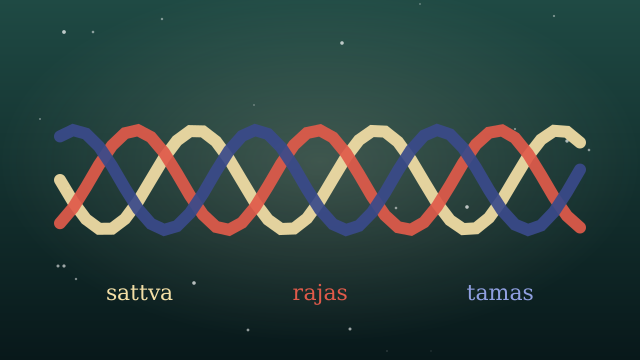 Illustration: the three gunas braided into one strand of nature
Purusha — pure consciousness. The witness. Unchanging, and never actually doing anything.
Prakriti — nature, or matter. Everything that changes: the body, the senses, thoughts, emotions, even the sense of “I” that claims them as its own.
Ordinary experience, in this account, is Purusha mistaking itself for Prakriti's activity — consciousness identifying with the thoughts passing in front of it, the way a light bulb might mistake itself for the shapes its light happens to be illuminating. The entire aim of yoga, on this view, is untangling that mistaken identification: not stopping the mind by force, but seeing clearly enough that Purusha stops being fooled by it.
Prakriti itself is described as made of three qualities, or gunas, in constantly shifting proportion:
Sattva — clarity, balance, lightness.
Rajas — activity, passion, restlessness.
Tamas — inertia, heaviness, dullness.
A calm, focused meditation session is, in Samkhya terms, a temporarily sattva-dominant state of the mind — not a different substance from an anxious, scattered one, just a different balance of the same three qualities in motion.
The most detailed classical source for the seven-chakra system most people know today is the Sat-Cakra-Nirupana, a 16th-century Bengali tantric text by Purnananda Swami — translated into English in 1919 by Sir John Woodroffe, writing under the pen name Arthur Avalon, in a book called The Serpent Power. That's the actual, traceable origin of most of what gets repeated about chakras today.
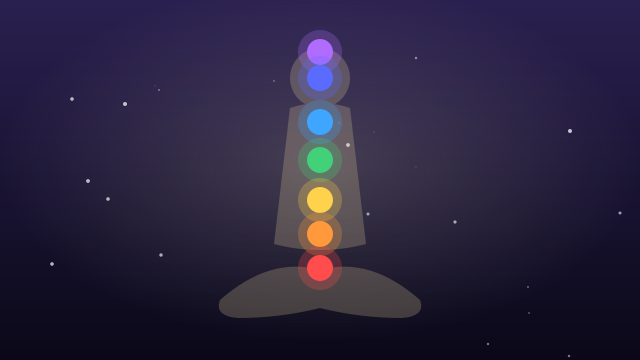 Illustration: the seven chakras as later tantric texts describe them
What the source texts describe is a set of energy centers along the subtle body's central channel (sushumna nadi), each defined by a specific number of lotus petals, a Sanskrit seed syllable (bija mantra) inscribed on each petal, and an associated presiding deity used in meditative visualization — a much more precise, ritual-and-visualization-based system than the vague “energy point” description usually given:
| Chakra | Location | Petals | Bija Mantra |
|---|---|---|---|
| Muladhara (root) | Base of the spine | 4 | Lam |
| Svadhisthana (sacral) | Below the navel | 6 | Vam |
| Manipura (navel) | Solar plexus | 10 | Ram |
| Anahata (heart) | Heart center | 12 | Yam |
| Vishuddha (throat) | Throat | 16 | Ham |
| Ajna (third eye) | Between the eyebrows | 2 | Om |
| Sahasrara (crown) | Crown of the head | 1,000 | — (beyond mantra) |
In the tantric and Kundalini Yoga traditions, dormant energy (kundalini, “coiled”) is said to rest at the base of the spine and rise through each of these centers in turn as it's awakened — see Kundalini and Chakra Meditation and Tantric Arts for the fuller practice context.
The rainbow color-coding (red root through violet crown), crystals, and self-help framing (“unlock your throat chakra to speak your truth”) are not in the Sanskrit sources. They're largely 20th-century Western additions, layered on as the system was popularized outside its original ritual and meditative context. None of that makes the modern versions useless — but it's worth knowing which parts are the original system of mantra-and-visualization practice, and which parts are later reinterpretation, before treating either as ancient scripture.
None of this is required to benefit from a chakra meditation or an asana practice. But knowing what's original and what's later reinterpretation is the difference between engaging with a tradition and just borrowing its aesthetic.
Yoga Sutras of Patanjali on Wikipedia · Britannica: Yoga philosophy · Samkhya