Banner: Kabir at his loom with a disciple, painting, 1825 — an imagined likeness; no portrait from life survives.
Kabir was a 15th-century poet-saint of Varanasi (Benares). Tradition says he was raised in a family of Muslim weavers, and the loom appears again and again in his poems. His dates are uncertain; most scholars place him in the 1400s, though legend stretches his life much further.
He wrote nothing down. His poems — short couplets (dohas) and longer songs (padas) — were sung, remembered and collected later, in the Bijak of the Kabir Panth, in Rajasthani manuscripts, and in the Sikh scripture, the Guru Granth Sahib, which includes hundreds of his verses.
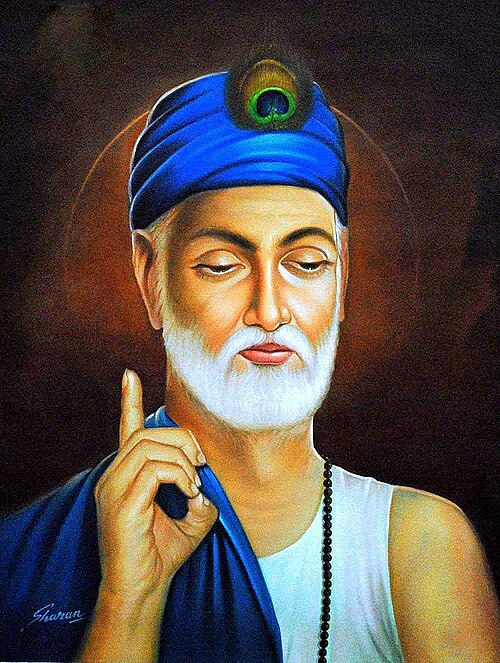 ShubhamSay, CC BY-SA 4.0
“O servant, where dost thou seek Me? Lo! I am beside thee.”Songs of Kabir I, tr. Rabindranath Tagore (1915)
Kabir taught devotion to a God without form or attributes (nirguna), whom he called Ram, Hari or Allah interchangeably. God is not in the temple or the mosque, in pilgrimages or rituals, but within. He mocked the pride of both Hindu priests and Muslim clerics with equal sharpness.
“I laugh when I hear that the fish in the water is thirsty.”Songs of Kabir, tr. Rabindranath Tagore (1915)
“It is needless to ask of a saint the caste to which he belongs.”Songs of Kabir II, tr. Rabindranath Tagore (1915)
In a society divided by caste and creed, Kabir insisted that a person is measured by devotion and honest living, not birth. His blunt, earthy language — full of images from the market, the loom and the household — made him a voice for ordinary people.
Because Kabir's poems were passed on by singers, they survive in three main streams, each with its own flavour. The Bijak, scripture of the Kabir Panth in eastern India, is the sharpest and most scornful of priests and clerics. The Rajasthani manuscripts collected as the Kabir Granthavali include more devotional and tender songs. The Sikh Guru Granth Sahib, compiled by Guru Arjan in 1604, preserves hundreds of his verses alongside those of the Sikh Gurus. Scholars compare all three to get closest to the historical voice.
 Illustration: Kabir the weaver: the loom runs through his poems
Kabir's word for the goal was sahaj, the natural or effortless state: not reached by austerities, pilgrimages or ritual baths, but by turning attention to the divine name already present within. He used the language of the Nath yogis, who sought liberation through the body, but turned it toward inner devotion and the guru's word.
“Between the poles of the conscious and the unconscious, there the mind has made a swing.”Songs of Kabir, tr. Rabindranath Tagore (1915)
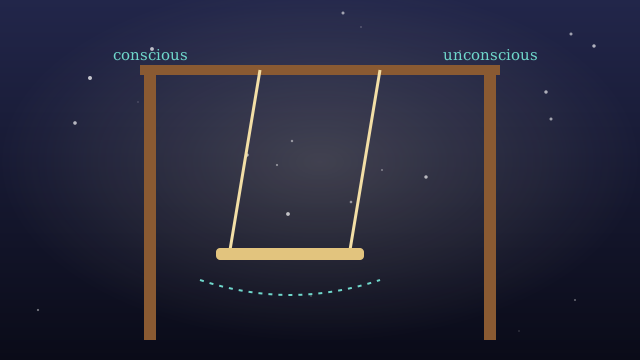 Illustration: the mind’s swing between the conscious and the unconscious
Some of his most famous poems are riddles in “upside-down language” (ulatbamsi): the cow milking the milkmaid, the fish climbing the tree. These puzzles jolt listeners out of habit, the way a Zen koan does, pointing to a truth that ordinary logic cannot reach.
Kabir's couplets return constantly to death: the body is a clay pot, life a few days at the market, and the clever person who postpones devotion is a fool. Against this he sets the true guru, whose word wakes the sleeper, and the divine name, repeated with love. Legend says he became the disciple of the famous teacher Ramananda by lying on the steps of a ghat in Varanasi before dawn, so that the guru, stepping on him in the dark, cried out “Ram!”, and Kabir took that as his initiation.
“If God be within the mosque, then to whom does this world belong?”Songs of Kabir, tr. Rabindranath Tagore (1915)
A well-known legend says that when Kabir died, Hindus wanted to cremate him and Muslims to bury him; lifting the sheet, they found only flowers, and divided them. Whether or not it happened, it captures his place between both communities. The Kabir Panth still follows his teaching, and his couplets are recited across India.
About the English translations: Tagore’s Songs of Kabir (1915), made with Evelyn Underhill, brought Kabir to the world, but it was based on a Bengali collection whose poems scholars do not all accept as Kabir’s own. Translations from the older Hindi sources read rather differently.