Albert Camus was born on 7 November 1913 in Mondovi, French Algeria. His father was killed at the Battle of the Marne in 1914, and Camus grew up in poverty in the working-class Belcourt district of Algiers, raised by his partially deaf, largely illiterate mother and a strict grandmother. A primary-school teacher, Louis Germain, saw his talent and pushed him toward a scholarship — decades later Camus dedicated his Nobel Prize speech to him. A gifted goalkeeper, he had to give up football when tuberculosis struck him at seventeen.
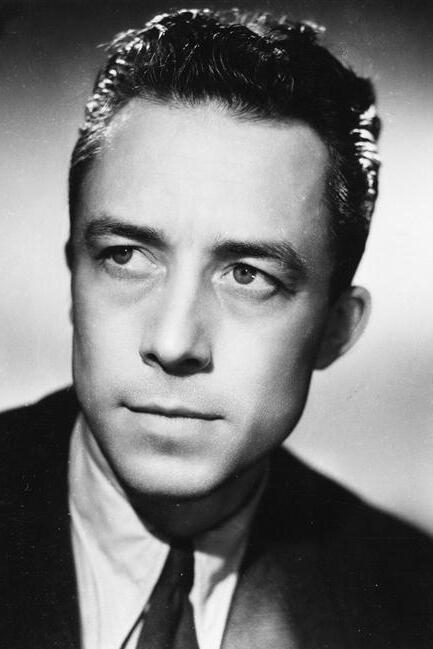 Studio Harcourt, 1945, public domain
Camus’ first major works — the novel The Stranger, the essay The Myth of Sisyphus (both 1942) and the play Caligula — form what he called his “cycle of the absurd.” The absurd, for Camus, is not the world itself but the collision between our hunger for meaning and a universe that answers with silence. He refused both escapes from it: suicide, and the “philosophical suicide” of a leap into faith. Instead he proposed revolt, freedom and passion — living fully while staying lucid. His symbol was Sisyphus, condemned to roll his boulder uphill forever: “The struggle itself toward the heights is enough to fill a man’s heart.”
During the Nazi occupation of France, Camus edited Combat, a clandestine Resistance newspaper. His novel The Plague (1947), about a town sealed off by an epidemic, was read as an allegory of occupation and of ordinary decency under pressure. In The Rebel (1951) he argued that revolt against injustice must limit itself, and attacked revolutionary movements that justified murder in the name of history. The book led to a public and bitter break with his friend Jean-Paul Sartre in 1952.
Camus is usually shelved beside Sartre and de Beauvoir, but he repeatedly rejected the existentialist label. Where Sartre built a philosophy of radical freedom, Camus was suspicious of systems altogether, and his work stays closer to the senses — the sun, the sea, the body — of his Algerian youth.
In 1957, at forty-four, Camus won the Nobel Prize in Literature, one of its youngest laureates. Less than three years later, on 4 January 1960, he was killed in a car crash near Villeblevin, France. In the wreck was the unfinished manuscript of The First Man, an autobiographical novel of his Algerian childhood, published in 1994.
Explore more about Albert Camus on Wikipedia.