Freedom, Choice, and Meaning
1. Introduction
Existentialism is the philosophical tradition that starts from a single, unsettling premise: there is no built-in blueprint for what a human life is supposed to be. You are simply thrown into existence first, and only afterward — through your choices — do you define who you are. Rather than treating this as a problem to be solved, existentialists treat it as the basic condition of being human, one that demands to be faced honestly rather than avoided.
2. Historical Background
- Søren Kierkegaard (1813–1855): Danish theologian often called the father of existentialism, who wrote about anxiety, despair, and the "leap of faith" required to live authentically.
- Friedrich Nietzsche: A major precursor, whose declaration that "God is dead" forced a reckoning with meaning in a universe without a given purpose.
- 20th-century France: Existentialism became a cultural movement through Jean-Paul Sartre, Albert Camus, and Simone de Beauvoir, shaped by the phenomenology of Edmund Husserl and Martin Heidegger.
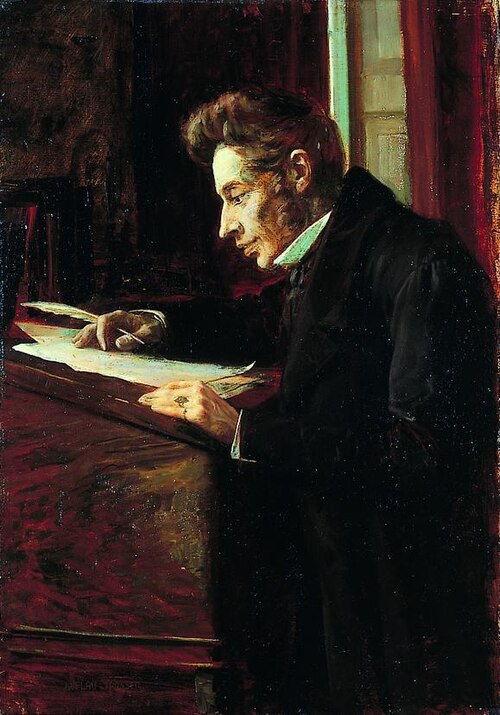 Luplau Janssen, 1902, public domain
3. Core Principles
- Existence precedes essence — Sartre's central claim: humans exist first, without a predetermined nature, and create their essence through action.
- Radical freedom and responsibility — because nothing is predetermined, every choice is genuinely yours, and so is its consequence.
- Authenticity vs. bad faith — living honestly according to your own values, versus hiding from freedom behind roles, excuses, or conformity.
- The Absurd — Camus's term for the tension between humanity's search for meaning and a universe that offers none by default.
4. Key Thinkers
- Jean-Paul Sartre: Argued that we are "condemned to be free" — even refusing to choose is itself a choice.
- Albert Camus: Explored the Absurd through the myth of Sisyphus, endlessly pushing his boulder uphill, concluding that one must imagine him happy anyway.
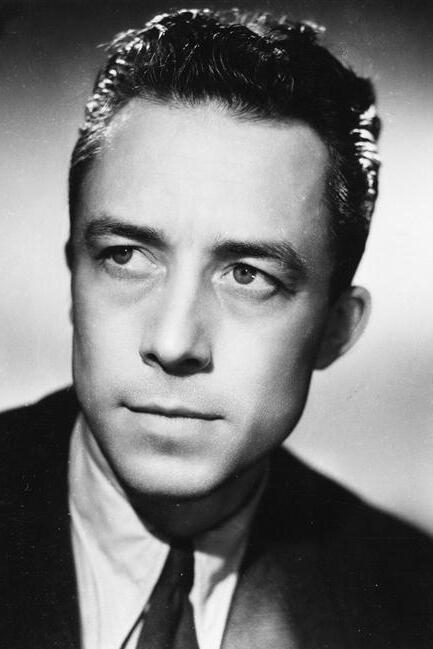 Studio Harcourt, 1945, public domain
- Simone de Beauvoir: Applied existentialist freedom to gender in The Second Sex, arguing "one is not born, but rather becomes, a woman."
- Søren Kierkegaard: Focused on the individual's subjective relationship to truth and faith over abstract systems.
5. Famous Quotes
"Man is condemned to be free." – Jean-Paul Sartre
"One must imagine Sisyphus happy." – Albert Camus
"Life can only be understood backwards; but it must be lived forwards." – Søren Kierkegaard
6. Existentialism in Modern Life
- Existential psychotherapy — helping people confront freedom, isolation, and mortality directly, rather than treating anxiety as purely clinical.
- Literature and film — existentialist themes run through everything from Camus's own novels to countless modern stories about identity and choice.
- Everyday relevance — a framework for facing career changes, personal reinvention, or any moment where an inherited script for life stops making sense.
7. Criticisms & Misconceptions
- Not nihilism — existentialists don't claim life has no meaning; they claim meaning isn't handed to you, and must be made.
- Not synonymous with despair — Camus explicitly argued that recognizing the Absurd can lead to a kind of defiant joy, not just anguish.
- Critiqued for individualism — some argue its heavy focus on personal freedom underweights social and structural constraints on people's choices.
8. Conclusion
Existentialism doesn't offer comfort in the form of pre-written answers. What it offers instead is a demand: to stop waiting for meaning to arrive, and to start building it — honestly, deliberately, and in full view of the freedom that makes it possible.