Rationalism holds that reason, not sensory experience, is the most reliable path to true knowledge. Where its great rival, empiricism, insists that everything we know ultimately traces back to observation, rationalists argue that some truths — mathematical, logical, even metaphysical — can be reached by thought alone, independent of what our unreliable senses report.
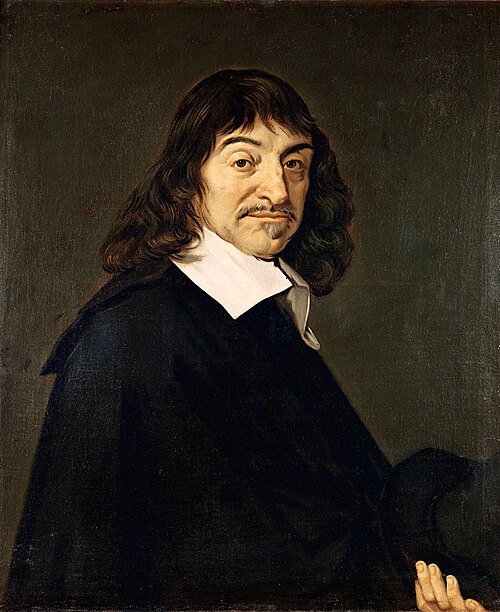 Frans Hals, 1649, Louvre, public domain
Together, Descartes, Spinoza, and Leibniz are usually grouped as the "Continental Rationalists," in contrast with the British empiricists (Locke, Berkeley, Hume) writing in the same era.
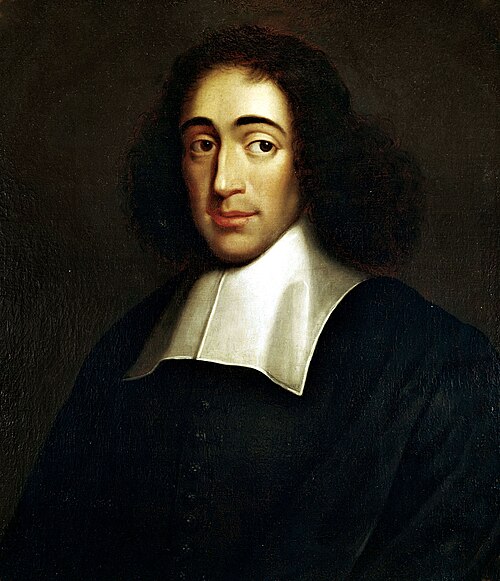 Anonymous, c. 1665, Herzog August Library, public domain
Descartes's search for certainty led him to doubt his senses, his body, even the existence of the external world — but he found one thing he could not doubt: the very act of doubting proved that a thinking thing existed to do the doubting. This became his famous starting point, cogito, ergo sum — "I think, therefore I am" — a single indubitable fact from which he tried to rebuild the rest of human knowledge.
The central debate of early modern philosophy pitted rationalists against empiricists like John Locke and David Hume, who argued the mind begins as a blank slate filled in only by experience. Immanuel Kant, covered elsewhere on this site, is famous for attempting a synthesis of the two — arguing that experience and reason both play indispensable roles in knowledge, neither sufficient alone.
"I think, therefore I am." – René Descartes
"The order and connection of ideas is the same as the order and connection of things." – Baruch Spinoza
"Nothing takes place without sufficient reason." – Gottfried Wilhelm Leibniz
Rationalism's enduring contribution isn't the claim that experience doesn't matter — it's the insistence that some truths can be reasoned toward with genuine certainty, and that careful, disciplined thought is itself a legitimate route to knowledge, not just a supplement to observation.
Rationalism on Wikipedia · Stanford Encyclopedia: Rationalism vs. Empiricism · Stanford Encyclopedia: Descartes