Kant’s prose is famously dense, so his best-known lines are often quoted in simplified form. References use the standard Academy edition (volume:page) or the A/B pages of the Critique of Pure Reason.
 Foto Wikimedia H.-P.Haack, CC BY-SA 3.0
“Act only according to that maxim through which you can at the same time will that it become a universal law.”Groundwork of the Metaphysics of Morals (1785), 4:421
Before you act, ask: could everyone live by the rule I am following?
“So act that you use humanity, whether in your own person or in the person of any other, always at the same time as an end, never merely as a means.”Groundwork, 4:429
People are never just tools — including you.
“It is impossible to think of anything at all in the world, or indeed even beyond it, that could be considered good without limitation except a good will.”Groundwork, 4:393
Talent, wealth and even happiness can be misused; only a good will is good in itself.
“Two things fill the mind with ever new and increasing admiration and awe: the starry heavens above me and the moral law within me.”Critique of Practical Reason (1788), Conclusion
The vastness outside and the sense of duty inside are equally worth wonder.
“Enlightenment is man’s emergence from his self-incurred immaturity.”“What Is Enlightenment?” (1784)
Most of our dependence on others’ judgment is chosen, not imposed.
“Sapere aude! Have courage to use your own understanding!”“What Is Enlightenment?” (1784)
Thinking for yourself takes nerve, not just intelligence.
“Thoughts without content are empty, intuitions without concepts are blind.”Critique of Pure Reason (1781), A51/B75
Experience and understanding only produce knowledge together.
“All our knowledge begins with the senses, proceeds then to the understanding, and ends with reason.”Critique of Pure Reason, A298/B355
Knowing is a process with stages, not a single act.
“Out of the crooked timber of humanity, no straight thing was ever made.”“Idea for a Universal History with a Cosmopolitan Purpose” (1784), Sixth Proposition
Any plan for people has to work with imperfect people.
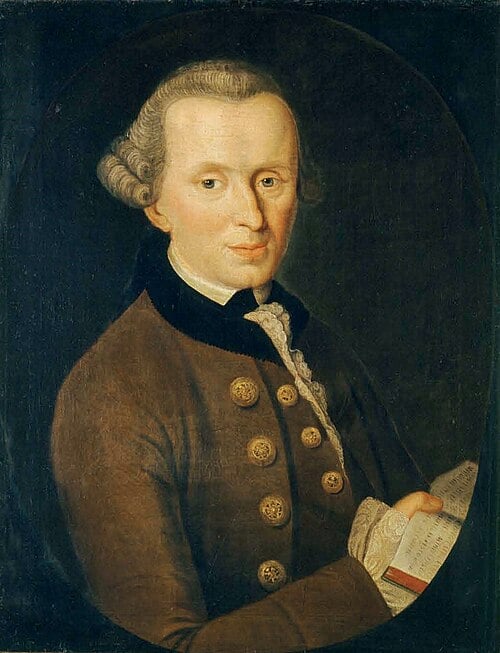 Kant in 1768, by J. G. Becker — public domain
These circulate widely under the same name, but don’t hold up:
Kant emphasized reason, morality, and duty. His categorical imperative teaches that actions should be guided by universal moral laws.
Immanuel Kant on Wikipedia · Stanford Encyclopedia: Kant · Kant: life and ideas