German Idealism and Marxism are two of the most influential philosophical movements to come out of 19th-century Germany — and despite one growing directly out of the other, they end up in almost opposite places. Idealism holds that reality is fundamentally shaped by mind, consciousness, or spirit. Marx took its core method and turned it upside down, arguing that material and economic conditions shape consciousness, not the other way around.
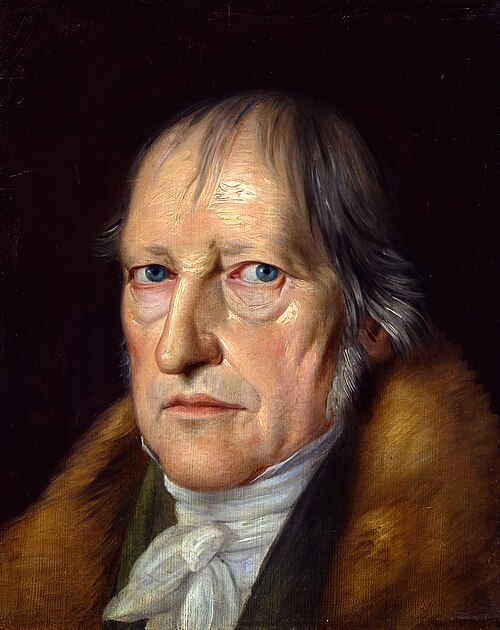 Jakob Schlesinger, 1831, Alte Nationalgalerie, public domain
Hegel's central tool is the dialectic: every idea, pushed far enough, runs into its own internal contradiction, and the contradiction is overcome by a richer idea that both cancels and preserves what came before. Hegel's word for this was Aufhebung, usually translated “sublation”. (The tidy formula “thesis, antithesis, synthesis” is often pinned on Hegel, but it comes from Fichte; Hegel himself almost never used it.) Hegel applied this pattern to the history of human freedom itself, arguing that societies and ideas develop through exactly this kind of conflict and resolution, moving — in his view — toward ever greater self-understanding and freedom.
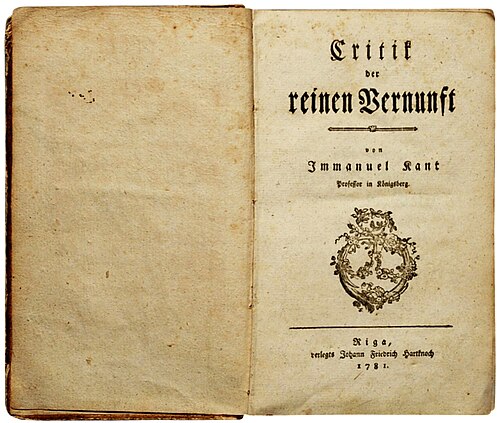 Kant’s Critique of Pure Reason (1781), where German idealism begins — Foto Wikimedia H.-P.Haack, CC BY-SA 3.0
Karl Marx (1818–1883) trained as a Hegelian but rejected Hegel's premise that history is driven by the unfolding of abstract Spirit. Marx kept the dialectic's engine — contradiction driving change — but swapped its fuel: for Marx, history is driven by material and economic conditions, not ideas. This is often summarized as turning Hegel's dialectic "right side up," replacing dialectical idealism with dialectical and historical materialism.
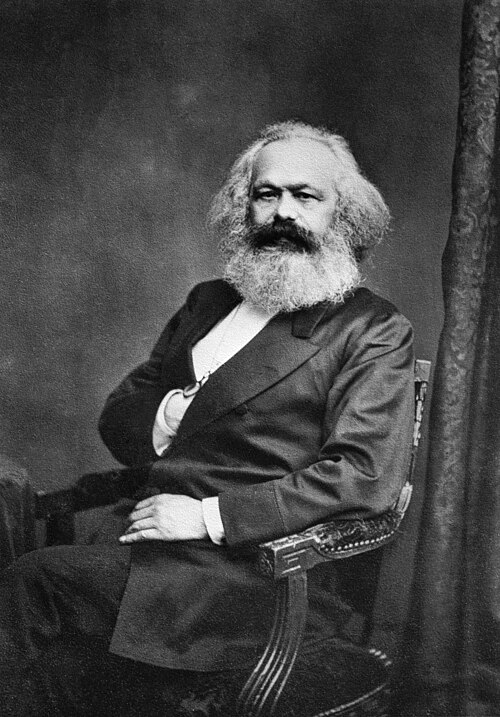 John Jabez Edwin Mayall, public domain
"The philosophers have only interpreted the world in various ways; the point, however, is to change it." – Karl Marx
"Religion is the sigh of the oppressed creature... it is the opium of the people." – Karl Marx
"The owl of Minerva spreads its wings only with the falling of the dusk." – G. W. F. Hegel
Whether you find Hegel's Spirit compelling or Marx's materialism more convincing, both insist on the same underlying claim: history isn't a random sequence of events, but a process with an internal logic worth understanding — a claim that continues to shape how historians, economists, and philosophers make sense of change.
German idealism on Wikipedia · Stanford Encyclopedia: Hegel · Stanford Encyclopedia: Karl Marx