Avram Noam Chomsky was born on 7 December 1928 in Philadelphia, Pennsylvania, the son of a Hebrew scholar who taught him early to read closely and question texts critically. He entered the University of Pennsylvania at sixteen, where he studied under the linguist Zellig Harris, whose structural approach to language would become one of the foundations Chomsky later built upon — and eventually broke sharply from. In 1955, Chomsky joined the Massachusetts Institute of Technology, where he would remain for the rest of his academic career, eventually becoming one of the most cited scholars alive in any field.
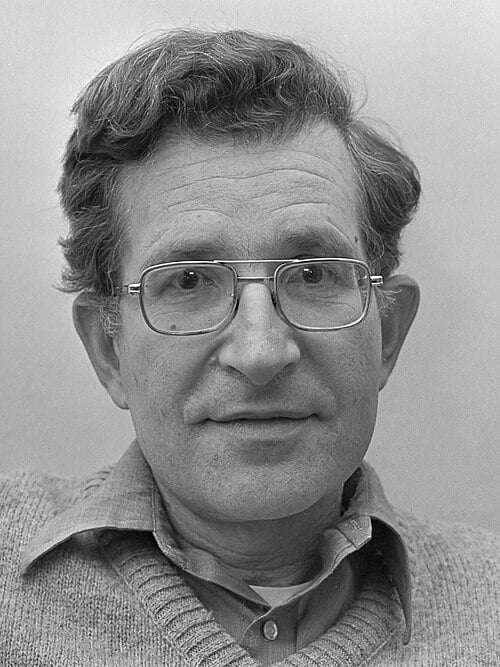 Noam Chomsky in 1977 — Hans Peters / Anefo, Nationaal Archief, CC0
In 1957, Chomsky published Syntactic Structures, a short but seismic book that reoriented the entire field of linguistics. Where earlier linguists treated language primarily as a learned set of habits built up through exposure and reinforcement, Chomsky argued that humans are born with an innate, biologically hardwired capacity for grammar — a "universal grammar" shared across all human languages, however different they appear on the surface. Children, he pointed out, learn the immensely complex rules of their native language from limited and often flawed input, far faster and more reliably than any simple learning-by-imitation model could explain. This argument formed the core of his devastating 1959 critique of B.F. Skinner's behaviorist account of language, a review widely credited with helping end behaviorism's dominance in psychology and linguistics.
Key Concepts: universal grammar, generative grammar, the poverty of the stimulus, critique of behaviorism
Related Topics: cognitive science, philosophy of mind, structural linguistics
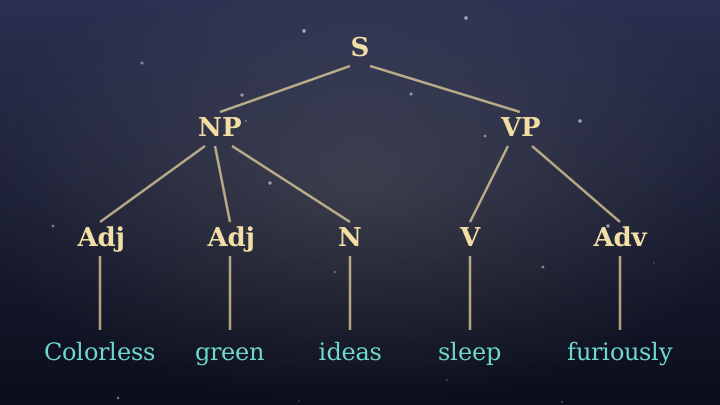 Illustration: Chomsky’s 1957 example from Syntactic Structures — perfectly grammatical, yet meaningless, so grammar cannot simply be meaning
Alongside his academic linguistics career, Chomsky became one of the most prominent public intellectuals of the American left, beginning with his outspoken opposition to the Vietnam War in the 1960s. His political writing has ranged across foreign policy, economics, and the mass media, most notably in Manufacturing Consent: The Political Economy of the Mass Media (1988), co-written with economist Edward S. Herman. The book proposed a "propaganda model" describing how commercial pressures, reliance on official sources, and concentrated media ownership can shape news coverage to favor established power — not primarily through outright censorship, but through the everyday incentives built into how news organizations operate.
Few thinkers have sustained two entirely separate, field-defining careers at once: Chomsky's technical linguistic theories transformed how scientists study the structure of the human mind, while his political writing — spanning dozens of books across six decades — has made him one of the most widely translated and cited critics of U.S. foreign policy and corporate media in the world, admired and criticized in roughly equal, passionate measure. He has continued publishing and lecturing into his nineties, on both linguistics and world affairs, a rare case of a single figure shaping two largely separate audiences at once.
Explore more about Noam Chomsky on Wikipedia.