Kabbalah (Hebrew for "receiving" or "tradition") is Jewish mysticism's esoteric current — a body of teaching concerned with the hidden structure of creation, the nature of God, and the soul's path back toward its divine source. Unlike Buddhist or Christian mystical traditions that often emphasize dissolving into unity, classical Kabbalah frequently emphasizes nothingness as the ultimate ground of being, alongside its more familiar imagery of divine emanation.
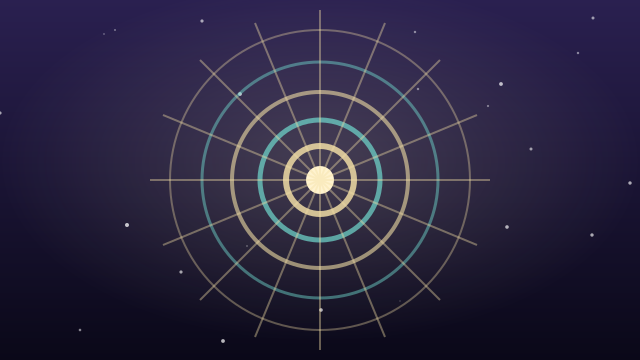 Illustration: Ein Sof, the infinite, imagined as light radiating outward
Kabbalah's roots reach back to early Jewish mystical speculation on the throne-vision in the Book of Ezekiel, and to the Sefer Yetzirah ("Book of Formation"), a short, dense cosmological text compiled sometime between the 3rd and 6th centuries CE. Kabbalah as a formalized system, however, crystallized in 12th- and 13th-century Provence and Spain, culminating in the Zohar ("Book of Splendor"), the tradition's central text, which appeared in Spain in the 1280s largely through the writings of Moses de León, who attributed it to the 2nd-century sage Shimon bar Yochai.
Kabbalah's best-known image is the Tree of Life: ten sefirot, or divine emanations, connected by twenty-two paths corresponding to the letters of the Hebrew alphabet. The tree maps how the infinite, unknowable divine — called Ein Sof, "the without end" — contracts and manifests itself in stages, descending from pure unity into the differentiated world we inhabit. The mystic's task is to trace this map back toward its source, ascending through contemplation and disciplined practice.
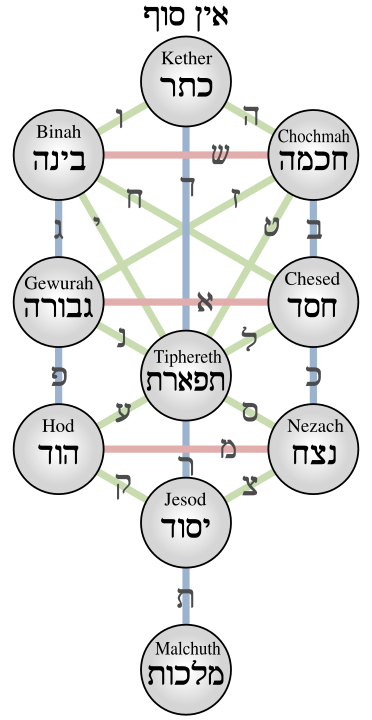
The Kabbalistic Tree of Life — ten Sephirot connected by 22 paths
Each sefirah carries its own character — from Keter ("crown," nearest to the infinite) through qualities like Chokmah (wisdom), Binah (understanding), Chesed (loving-kindness), and Gevurah (severity), down to Malkhut ("kingdom"), the physical world itself.
The 16th-century mystic Isaac Luria, working in the Galilean town of Safed, reshaped Kabbalah around a dramatic creation myth: God's infinite light, poured into finite vessels at creation, shattered them, scattering divine sparks throughout the material world and mixing them with brokenness and exile. Human beings, through prayer, ethical action, and mystical intention, are tasked with gathering these scattered sparks and repairing the fracture — a process called tikkun olam, "repair of the world."
This idea gave Kabbalah a strong ethical and communal dimension alongside its speculative cosmology, and tikkun olam has since become a widely used phrase in Jewish social-action movements, well beyond mystical circles.
From the Renaissance onward, Christian scholars developed their own adaptation, Christian Kabbalah, reading the sefirot through a Trinitarian and messianic lens. Later, 19th-century ceremonial magic societies such as the Hermetic Order of the Golden Dawn absorbed Kabbalistic structure into a broader Western esoteric synthesis alongside Hermeticism, astrology, and tarot — a use that traditional Kabbalists generally regard as a significant departure from the tradition's original Jewish religious context.
Key People: Moses de León, Isaac Luria, Isaac ben Solomon Luria
Key Texts: Sefer Yetzirah, the Zohar
Related Topics: Ein Sof, tikkun olam, the 22 Hebrew letters, Hermeticism
Kabbalah on Wikipedia · Zohar on Wikipedia · Britannica: Kabbala