Epictetus was born around 50 CE in Hierapolis, in Phrygia (near modern Pamukkale, Turkey), into slavery — his name simply means “acquired.” His owner was Epaphroditus, a wealthy freedman who served as secretary to the emperor Nero. Epictetus was lame; one ancient account blames a cruel master who twisted his leg until it broke, while another says it was rheumatism. Either way, he never spoke of his disability as an injury to himself, only to his leg.
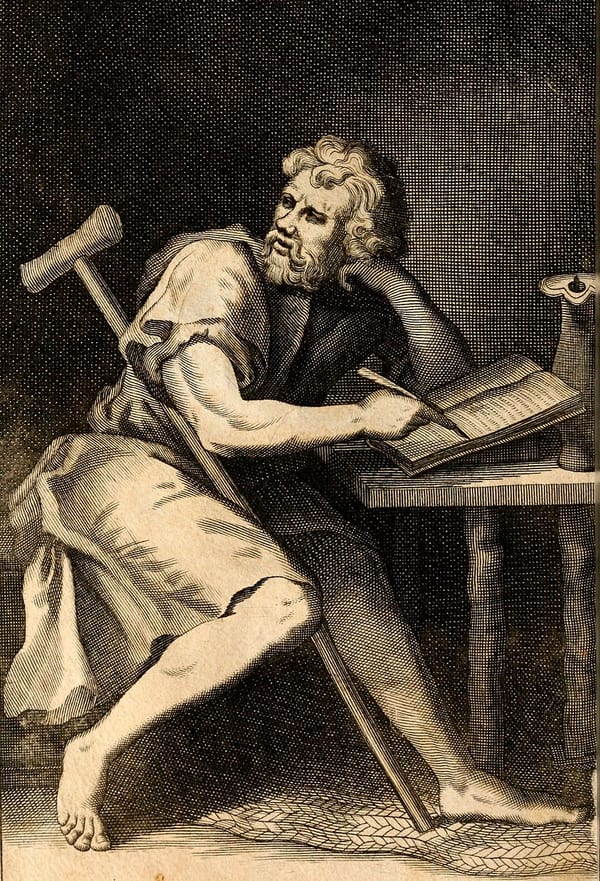 An imagined portrait — no likeness of Epictetus survives — engraved for a 1715 Oxford edition of the Enchiridion (William Sonmans / Michael Burghers). Public domain (source)
While still enslaved, he was allowed to study with Musonius Rufus, the leading Stoic teacher in Rome. At some point after Nero’s death in 68 CE he was freed, and began teaching philosophy himself. Around 93 CE the emperor Domitian banished philosophers from Rome, and Epictetus moved to Nicopolis in north-western Greece, where he founded a school that drew students from across the empire. He lived simply, reportedly with little more than a straw mat and a lamp, and died there around 135 CE.
Like Socrates, Epictetus wrote nothing. His student Arrian of Nicomedia — later a historian of Alexander the Great — recorded his lectures as the Discourses, of which four books survive, and distilled them into the short Enchiridion (Handbook). They read like a coach talking: blunt, funny, impatient with excuses, and endlessly practical.
Everything in Epictetus flows from one distinction, set out in the Handbook’s first line: some things are up to us — our judgments, choices, desires and aversions — and some are not: our body, property, reputation and everything else outside the mind. Suffering comes from treating the second kind as if it were the first. “It is not things that disturb us,” he says, “but our judgments about things.” A man who was once owned by another drew the obvious conclusion: no one can enslave your will unless you hand it over.
Marcus Aurelius thanked his tutor Rusticus for lending him Epictetus’ lecture notes, and the emperor’s Meditations are full of them. The Handbook was adapted for Christian monks, admired by Montaigne and Pascal, and carried through seven years as a prisoner of war in Vietnam by US pilot James Stockdale. In the 20th century Albert Ellis, a founder of cognitive behavioural therapy, named Epictetus as an influence — the idea that changing our judgments changes how we feel is now a clinical technique.
Explore more about Epictetus on Wikipedia.