Empiricism is the view that knowledge comes from experience — from what we see, hear and touch — rather than from reason alone or ideas we are born with. It is the philosophical root of the scientific habit of checking ideas against observation, and it stands opposite rationalism, which trusts reason to reach truths on its own.
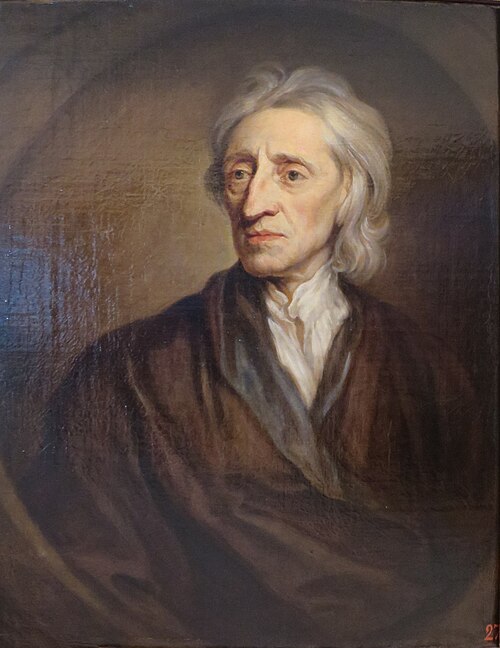 Godfrey Kneller, 1697, Hermitage Museum, public domain
The idea is ancient. Aristotle held that knowledge begins with perception, and medieval philosophers summed it up in the maxim “there is nothing in the intellect that was not first in the senses”, which Thomas Aquinas quotes. In 1620 Francis Bacon’s Novum Organum called for a new science built patiently from observation and experiment, rising step by step from particular facts to general laws.
“Let us then suppose the mind to be, as we say, white paper, void of all characters, without any ideas.”John Locke, An Essay Concerning Human Understanding (1689), II.1.2
John Locke (1632–1704) argued against “innate ideas”. The mind starts out blank, and every idea in it comes either from the senses or from reflecting on the mind’s own workings. He also distinguished qualities really in objects, such as shape and motion, from those that exist only in our perception of them, such as colour and taste.
 Illustration: the mind as a blank slate, written on by experience through the senses
George Berkeley (1685–1753) pushed Locke further. If all we ever know are our perceptions, what entitles us to believe in matter existing behind them? His answer was startling: nothing does. For things to exist is for them to be perceived — and the world continues when we look away because it is always perceived by God.
David Hume (1711–1776) followed empiricism to its most unsettling conclusions. We never perceive causation itself, he argued — only one event regularly followed by another; our belief that the future will resemble the past is a habit, not a proof. This “problem of induction” has troubled philosophers ever since.
“Reason is, and ought only to be the slave of the passions.”David Hume, A Treatise of Human Nature (1739), 2.3.3
Immanuel Kant said Hume woke him from his “dogmatic slumber”, and tried to combine both camps: knowledge begins with experience, but the mind supplies the forms that organise it. In the 20th century the logical positivists made experience the test of meaning, and Karl Popper replied to Hume by arguing that science advances not by proving theories from observations but by trying to refute them.