Each of these traditions approaches stillness differently. Pick the one that fits where you're at.
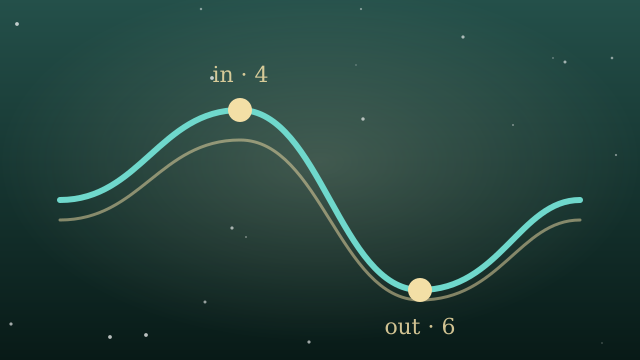 Illustration: a slow breath rhythm, the foundation of most practices

Ripples settling toward a still centre — the quieting of the mind TM aims for
Transcendental Meditation was developed by Maharishi Mahesh Yogi, who began teaching it in India and then worldwide from the late 1950s. It became famous in 1968, when the Beatles spent several weeks at his ashram in Rishikesh.
 Om, the sacred syllable often used as a mantra — Public domain
The method is deliberately easy. You sit with eyes closed and silently repeat a mantra, a sound given to you by a teacher. You don't try to concentrate or push thoughts away: when you notice you have drifted, you return to the mantra gently. Practitioners say attention settles of its own accord into quieter and quieter levels of thought.
TM is taught only through a paid course with a certified teacher, and the mantras are kept private, which some find off-putting. Research suggests it can lower stress and blood pressure a little: a 2013 American Heart Association review said it may be considered as an add-on for high blood pressure, while noting that many studies were small or run by researchers connected to the movement.
To try the idea: sit for ten minutes and silently repeat a calm, meaningless sound or a simple word. When you notice your mind has wandered, return to it without fuss. This isn't TM itself, but it gives you a taste of mantra meditation.

Vipassana means “insight” — seeing things as they really are
Vipassana is a Pali word meaning “seeing clearly” or “insight”. Its roots are in the Buddha's discourse on the four foundations of mindfulness, the Satipatthana Sutta: attention to the body, to feelings as pleasant, unpleasant or neutral, to states of mind, and to the patterns of thought that shape them.
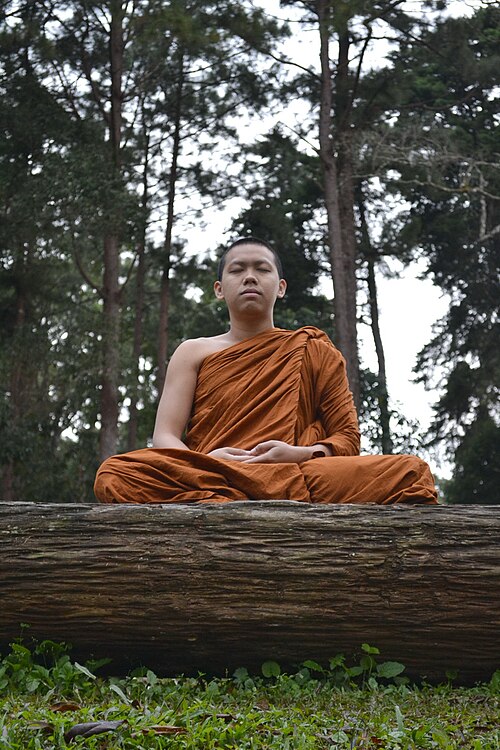 ผู้สร้างสรรค์ผลงาน/ส่งข้อมูลเก็บในคลังข้อมูลเสรีวิกิมีเดียคอ, CC BY 3.0
In practice you usually begin with the breath, feeling it at the nostrils or the belly. When attention wanders, you notice where it went — “planning”, “remembering”, “itching” — and come back. Over time you widen the attention to sensations throughout the body, watching them change from moment to moment. The aim is insight into three marks the Buddha taught: everything is impermanent, nothing impermanent can fully satisfy, and there is no fixed self behind experience.
In the 20th century, Burmese teachers made vipassana available to lay people. Mahasi Sayadaw taught a method of mental noting, and S. N. Goenka, from the lineage of U Ba Khin, began offering ten-day silent courses in India in 1969; they are still run worldwide on a donation basis. Jon Kabat-Zinn's Mindfulness-Based Stress Reduction (1979) adapted these methods for hospitals, and most modern mindfulness apps descend from it.

The ensō — a circle drawn in one brushstroke, a classic image of the Zen mind
Zazen simply means “seated meditation”. It is the heart of Zen, the school of Buddhism that grew up in China as Chan and spread to Korea, Japan and Vietnam. The Japanese teacher Dogen (1200–1253) wrote a short guide, the Fukanzazengi (“Universal Recommendation for Zazen”), that is still read before sitting in many Zen halls.
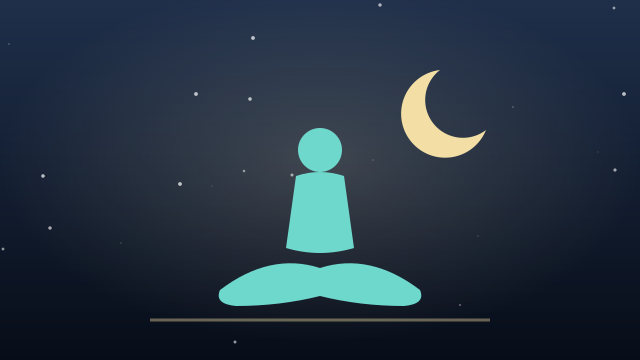 Illustration: just sitting — the heart of zazen
The posture matters. You sit on a cushion in full or half lotus, kneeling, or on a chair, with the spine upright and the chin slightly tucked. The hands rest in the lap, left palm on right, thumbs lightly touching to form an oval. The eyes stay half open, resting on the floor about a metre ahead. Beginners often count breaths from one to ten and start again.
The two main schools then go different ways. Soto Zen practises shikantaza, “just sitting”: no object, no goal, simply being present. Rinzai Zen adds the koan, a riddle such as Hakuin's “What is the sound of one hand?”, meant to exhaust the thinking mind until something deeper breaks through.

Metta, the practice of loving-kindness — goodwill radiating outward
Metta is Pali for loving-kindness or friendliness. It is the first of four qualities Buddhism calls the “divine abodes” (brahmaviharas): loving-kindness, compassion, joy in others' happiness, and equanimity. The Karaniya Metta Sutta asks the practitioner to cherish all beings as a mother protects her only child.
In the 5th century, the commentator Buddhaghosa, in his Path of Purification, laid out the sequence most teachers still use: begin with yourself, then a dear friend, then a neutral person, then someone you find difficult, and finally all beings everywhere. Some studies suggest that regular practice increases positive emotions and feelings of connection.
 Illustration: metta: wishing others well, one person at a time
If warmth doesn't come, that's normal. The practice is the repeated wishing, not a particular feeling.
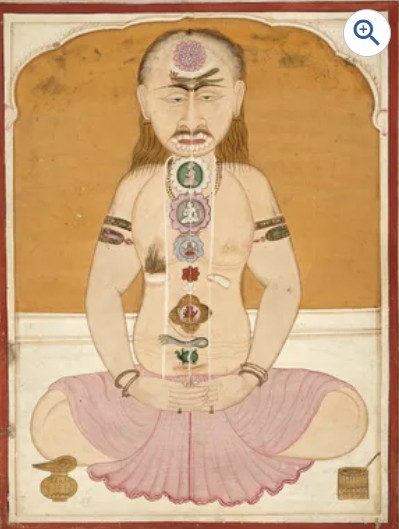
The chakras as modern yoga usually maps them along the spine
In tantric yoga, the body is mapped as a subtle network of channels (nadis) and centres called chakras, “wheels”. A dormant energy, kundalini (“the coiled one”), is pictured as a serpent asleep at the base of the spine. Practice aims to wake it and draw it up the central channel, through each chakra, to the crown, where its union with pure consciousness brings liberation.
The system most people know comes from one text, the Sat-Chakra-Nirupana (1577), which describes six chakras and the thousand-petalled lotus above them. Older texts count differently, and the rainbow colours and psychological meanings now attached to each chakra were added in the 20th century, largely in the West (see The Philosophy Behind the Practice).
 Illustration: the chakras as modern yoga usually places them along the spine
Open any chakra below for its traditional name, place and symbols:
Meaning: root support. Place: base of the spine. Petals: 4. Element and seed sound: earth, seed sound lam.
Meaning: one’s own seat. Place: genital region. Petals: 6. Element and seed sound: water, vam.
Meaning: city of jewels. Place: navel. Petals: 10. Element and seed sound: fire, ram.
Meaning: unstruck (sound). Place: heart. Petals: 12. Element and seed sound: air, yam.
Meaning: purification. Place: throat. Petals: 16. Element and seed sound: space (ether), ham.
Meaning: command. Place: between the eyebrows. Petals: 2. Element and seed sound: mind, om.
Meaning: thousand-petalled. Place: crown of the head. Petals: 1,000. Element and seed sound: beyond the elements.
A gentle way in: sit upright and breathe slowly. On each in-breath, imagine the breath rising from the base of the spine to the crown; on each out-breath, let it settle back down. Keep it soft. Forceful breathing and long breath-holding, common in some kundalini classes, can cause dizziness or anxiety, so learn them from an experienced teacher.

Trataka: a single steady point of focus
The Hatha Yoga Pradipika describes trataka as gazing, without blinking, at a small object until the eyes water (2.31–32). It lists trataka among the six cleansing practices and, like many old texts, credits it with curing eye diseases, a claim modern medicine doesn't support. Today it is mostly valued as a concentration exercise: the eyes give the restless mind one simple job.
 Illustration: trataka: the steady gaze on a single flame
Skip trataka if you have epilepsy, migraines triggered by light, or an eye condition, and stop if your eyes hurt.
Zazen on Wikipedia · Mettā on Wikipedia · NIH: Meditation and mindfulness